
July 16, 2026
How to Continue With the Original Source Material Between Anime Seasons

Understanding What Happens Between Anime Seasons
When an anime season ends, the safest way to continue is not to search for “the next chapter” and immediately start reading. First confirm which publication the anime actually adapts, then check whether the season skipped, rearranged, or substantially changed any material.
For a faithful manga adaptation, beginning near the final adapted chapter may be enough. For a light-novel adaptation or a series known for heavy cuts, starting from the beginning of the last adapted volume—or even from volume one—usually produces a clearer experience.
The right starting point therefore depends on two questions: Which version is the primary source, and how closely did the anime follow it?
Confirm the Primary Source Before Choosing a Starting Point
An anime may be connected to several publications carrying the same title. A light novel can inspire both a manga adaptation and an anime, while a web novel may have been revised substantially before its commercial light-novel release. Continuing with the wrong version can lead to different character details, altered story arcs, or material that does not align with the anime.
Start with the anime’s official website, opening or ending credits, publisher information, or licensed streaming description. Look for wording such as “original work,” the creator’s name, the publishing imprint, or the magazine in which the source appears. Database pages on services such as MyAnimeList and AniList can help identify related works, but use them as navigation tools rather than final proof.
Pay particular attention when several versions exist:
| Anime situation | Source most likely to continue the main story | What to check |
|---|---|---|
| Anime adapted directly from a manga | Original manga | Author, magazine and publisher |
| Anime adapted from a light novel | Light-novel edition | Novel imprint and credited author |
| Web novel later revised as a light novel | Usually the published light novel | Whether the anime credits the novel edition |
| Anime has both novel and manga versions | The version credited as the original work | Do not assume the manga came first |
| Original anime project | No direct source may exist | Look for sequels, films or official spin-offs instead |
The publication timeline alone is not always enough. A manga may have started before the anime while still being an adaptation of an earlier novel. The decisive evidence is the work credited by the anime as its source.
Once the source is confirmed, verify whether an official edition exists in a language and region you can use. Licensed catalogs such as BOOK WALKER Global and VIZ provide official manga or light-novel access, but their title selections and regional availability differ. Public-library apps may also carry digital editions, although each library builds its own collection.
Choose a Starting Point Based on What the Anime Changed
The chapter adapted by the final episode is only a reference point. It is not automatically the best place to begin.
Anime episodes are built around broadcast length and seasonal structure. A production may combine several chapters, move a later scene forward to create a stronger finale, shorten explanations, remove side stories, or stop in the middle of a novel volume. A guide that says “continue from chapter 48” may identify the first unadapted chapter without warning that chapters 42–47 contained omitted material.
Use the following approach:
| Adaptation pattern | Recommended starting point |
| Very faithful manga adaptation with few reported omissions | Read the final adapted chapter, then continue |
| Mostly faithful adaptation with several compressed scenes | Start a few chapters before the reported endpoint |
| Light-novel adaptation with reduced internal narration or world-building | Start at the beginning of the last adapted volume |
| Adaptation that rearranged arcs or changed major events | Start from volume one or the beginning of the affected arc |
| Unclear or conflicting continuation guides | Compare the final anime episodes with the relevant volume before reading ahead |
The most efficient method is to locate the volume containing the season finale and review its table of contents, chapter descriptions, or opening pages. Begin with the last material you clearly recognize. If new characters, unexplained relationships, or unfamiliar events appear immediately, move backward rather than trying to reconstruct the missing context later.
Light novels deserve extra caution. An anime can reproduce the visible events while omitting internal reasoning, political explanations, world-building, and alternate viewpoints. These omissions may not make the anime confusing, but they can become important in later volumes. Starting one volume earlier is often a better compromise than restarting the entire series.
Side stories also need to be judged by relevance. Some are optional comedy or bonus material, while others introduce characters and events used later. Check whether later chapters refer back to them before deciding to skip them.
Avoid relying on a single forum comment, wiki entry, or search snippet. Continuation guides can become outdated after recap films, revised editions, split cours, or additional episodes are released. Compare at least two references and confirm the answer against the published volume whenever possible.
Decide Whether Reading Ahead Improves the Experience
After finding the correct source and starting point, decide whether you actually want to continue beyond the anime.
Reading ahead is usually a good fit when the release date of another season is uncertain, the original publication contains substantially more detail, or your main priority is discovering the rest of the story. Waiting may be better when animation, voice acting, music, and weekly suspense are central to your enjoyment.
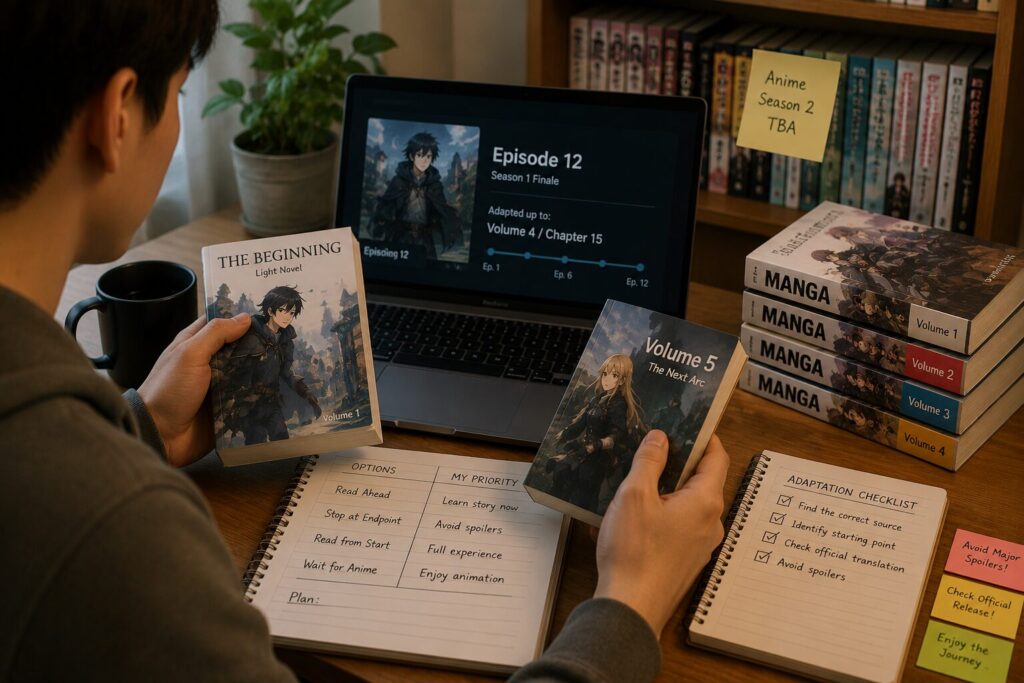
There is also a middle option: read only the material the anime has already covered. This lets you recover omitted scenes and understand the source’s style without learning future plot developments. You can then stop at the adaptation endpoint and remain unspoiled.
| Your priority | Most suitable choice |
| Learn what happens immediately | Continue into the next unadapted material |
| Preserve future anime surprises | Do not read beyond the adaptation endpoint |
| Understand omitted details without major spoilers | Read only the already-adapted volumes |
| Experience the author’s complete version | Begin from volume one |
| Avoid buying the same material twice | Sample or borrow the final adapted volume first |
| Official translation is far behind | Wait, read another licensed language edition you understand, or follow non-spoiler publication updates |
When an official translation is unavailable, first check whether another licensed regional edition exists or whether the publisher has announced a release. Plot summaries and community discussions may reveal what happens, but they are not substitutes for the original text and often contain unmarked spoilers or interpretation errors.
Unofficial translations may also vary in completeness, terminology, and legal status. The most reliable long-term option is an official edition from the publisher, licensed retailer, or participating library. Buying or borrowing an official release supports the licensed publication, although it should not be presented as a guarantee that another anime season will be produced.
Before committing to a full series, obtain the volume containing the anime’s ending and compare it with the final episodes. That single check will tell you whether you can continue directly, need to move backward, or would benefit from restarting the source from the beginning.