
July 16, 2026
How to Continue With the Original Source Material Between Anime Seasons
An anime season does not always stop at a clean boundary in its source material. The final episode may adapt the end of a manga chapter, combine scenes from several chapters, or stop halfway through a light-novel volume after moving a later scene forward to create a stronger finale.
For that reason, searching only for “what chapter comes after the anime” can produce an incomplete answer. The first chapter that was not animated is not necessarily the best place to begin reading. Important dialogue, character thoughts, side stories, and explanations may have been shortened or removed before that point.
A dependable continuation plan requires four decisions. First, identify which publication the anime officially credits as its source. Next, confirm the volume and chapter covered by the last episode. Then compare the adaptation with the original to determine how far back to begin. Finally, decide how much future material to read without damaging the experience you hope to have if another season is produced.
Identify the Exact Source Edition
Many anime titles are connected to several publications. A web novel may be revised into a commercial light novel, which later receives both a manga adaptation and an anime. All four versions can share the same title while containing different dialogue, chronology, character details, and story arcs.
Do not assume that the manga is the original merely because it is easier to find. The manga may itself be an adaptation of a light novel. Likewise, an older web novel is not always the version followed by the anime if the published novel substantially revised the story.
Begin with the anime’s official website, opening or ending credits, production information, licensed streaming description, or publisher page. Look for an “original work” credit, the author’s name, the publication imprint, and the magazine or digital platform associated with the source.
Record the following details:
| Detail | Information to confirm |
|---|---|
| Original creator | Author and, where relevant, illustrator |
| Credited source | Manga, light novel, novel, game or original project |
| Publisher | Company responsible for the source edition |
| Imprint or magazine | The exact commercial edition adapted |
| Japanese title | Useful when translated titles differ |
| Licensed title | Name used by the official regional publisher |
These details prevent several common mistakes. A reader may accidentally buy the manga when the anime follows the light novel, begin with an unrevised web novel, or confuse a side-story series with the main publication.
Databases and fan wikis are useful for locating likely editions, but the final identification should be checked against official credits or publisher records. Community pages can combine related works under one title and may not clearly distinguish the source from later adaptations.
Original anime projects require a different approach. When no manga, novel, or game is credited as the source, there may be no publication that continues directly after the final episode. A manga released alongside the anime may retell or expand the same story rather than function as its continuation. In that situation, look for an announced sequel, film, drama CD, official novelization, or franchise spin-off instead of assuming that a source ending already exists.

Establish the Last Material the Anime Actually Covered
Once the source edition is confirmed, determine how far the season progressed. Search for the last manga chapter, light-novel chapter, or volume represented in the final episode.
Use more than one reference. The anime’s official site and publisher may describe the adapted arc, while volume summaries, chapter lists, end-of-volume notes, and reliable fan-maintained references can help identify individual scenes. The result becomes more dependable when the same endpoint is supported by both the published material and a detailed episode comparison.
Do not rely only on an episode-to-chapter number posted in a search result. First confirm that both sources use the same numbering system. Digital chapters, collected volumes, bonus chapters, prologues, side stories, and revised editions may all be counted differently.
A manga continuation guide may state that the season ends at chapter 48, but chapter 48 could refer to the magazine release while the collected edition labels the same material differently. Light-novel guides can be even less precise because an episode may adapt scenes from several chapters or rearrange events across one volume.
The most reliable method is to inspect the source volume containing the final anime scenes.
Find two or three unmistakable checkpoints, such as:
- The final battle or confrontation
- A character’s departure or arrival
- A major confession or revelation
- The last location shown in the episode
- A closing conversation
- The beginning of a new arc
Locate those moments in the official source edition and read the surrounding pages. Do not stop at the first familiar panel or paragraph. The anime may have borrowed that scene from a later chapter while leaving earlier material unadapted.
A simple comparison record helps:
| Anime event | Source location | Adaptation note |
| Final battle begins | Volume 5, Chapter 3 | Several explanations shortened |
| Supporting character returns | Volume 5, Chapter 4 | Scene moved earlier in anime |
| Season-ending conversation | Volume 5, Chapter 6 | Used before two omitted scenes |
| Next unadapted event | Volume 5, Chapter 5 | Actually occurs before the anime ending |
In this example, beginning with Chapter 7 would skip Chapter 5 even though the finale visually resembles Chapter 6. The correct continuation point is determined by story order, not merely by the last scene adapted.
Decide How Far Back to Begin
After locating the endpoint, inspect how much the anime changed. A faithful adaptation may allow the reader to begin with the final adapted chapter and continue immediately. A heavily compressed adaptation may require restarting the last volume, the current arc, or the entire source.
Anime productions must fit episodes into fixed running times and seasonal structures. Dialogue can be shortened, internal narration removed, side characters reduced, and scenes moved to produce a satisfying opening or finale. These changes do not always alter the central plot, but they can affect how later developments are understood.
Use the adaptation pattern to select a starting point:
| Adaptation pattern | Practical reading point |
| Nearly panel-for-panel manga adaptation | Read the final adapted chapter again |
| Faithful story with shortened dialogue | Begin two or three chapters earlier |
| Several omitted scenes in the final arc | Start at the beginning of that arc |
| Light novel with reduced internal narration | Start with the last adapted volume |
| Events reordered across volumes | Begin before the first major rearrangement |
| Major characters or plotlines removed | Consider starting from Volume 1 |
Reading the final adapted chapter again is usually worthwhile even for a faithful manga adaptation. It provides a transition from animated pacing to the source’s paneling, narration, and terminology. It also reveals where the anime stopped inside the chapter rather than assuming that the entire installment was covered.
Light novels require more caution. An anime can reproduce every major visible event while removing the protagonist’s reasoning, political background, world-building, and alternate viewpoints. Those details may appear optional during the animated arc but become necessary in later volumes.
Starting at the beginning of the final adapted light-novel volume is often a practical compromise. It avoids restarting a long series while restoring context that may be important after the season endpoint.
Move farther back when the first new chapter contains unexplained relationships, unfamiliar terminology, or references to events you do not remember. Those are signs that the adaptation omitted material rather than evidence that the source suddenly became confusing.
Side stories should be judged by later relevance. A comedy bonus with no lasting consequences can often be skipped. A side chapter that introduces a character, explains an ability, or establishes an agreement may be needed when the main story later assumes that the reader already knows it.
Use a Licensed Edition With Stable Terminology
Once the starting point is known, locate an official edition available in a language and region you can use.
Licensed translations generally provide consistent character names, ranks, places, abilities, and technical terms across volumes. This reduces confusion when comparing the source with subtitles, dubbed dialogue, promotional material, or a future anime season.
Official digital services include publisher-operated platforms and licensed retailers. MANGA Plus identifies itself as a service directly managed by Shueisha and provides official releases from the publisher. BOOK WALKER Global offers licensed manga and light novels, while VIZ distributes official print and digital manga through its website, applications, and retail partners. Availability still varies by title and region.
Check several legal routes before concluding that the source is unavailable:
- The original publisher’s regional website
- A licensed manga or light-novel retailer
- An official chapter-reading service
- Print and digital bookstore listings
- A public library’s digital catalog
- The regional license holder’s release calendar
Confirm the edition before purchasing. Some stores list the manga adaptation and light novel on adjacent pages with nearly identical covers. Look for format labels such as “Manga,” “Light Novel,” “Novel,” or “Omnibus.”
Volume numbering can also differ between physical and digital releases. An omnibus may contain two or three standard volumes. A collector’s edition may renumber books or include bonus chapters in a different order. Compare the table of contents with the ordinary edition before using a continuation guide based on standard volume numbers.
Official availability may lag behind the Japanese release. When the licensed translation has not reached the anime endpoint, check the publisher’s announced schedule rather than assuming the series was abandoned. Another licensed language edition may be suitable if you can read it comfortably.
Unofficial translations may use different names, omit text, stop unexpectedly, or follow another source edition. Their legal status also depends on authorization from the rights holder. They should not be treated as equivalent to an official continuation simply because they have more chapters.
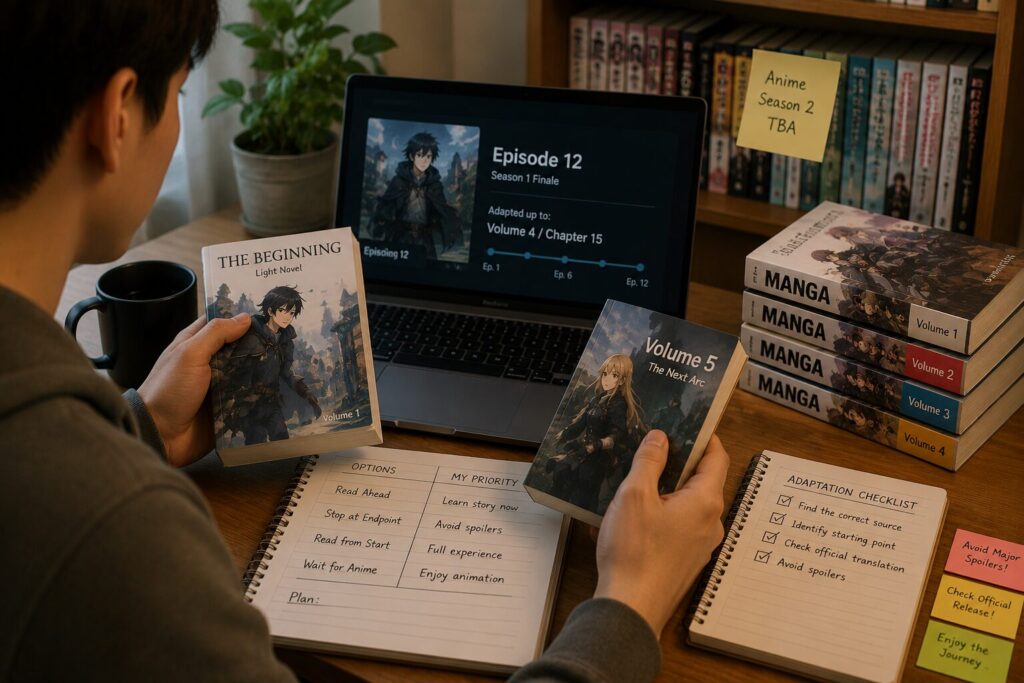
Set a Spoiler Boundary Before Reading Ahead
Continuing the source changes the way a future anime season will be experienced. Plot twists, character introductions, deaths, relationships, and arc endings will no longer be new when they are animated.
That does not make reading ahead the wrong choice. It means the reader should decide which experience matters more.
Readers who mainly want the complete story can continue beyond the adaptation endpoint. Those who value animation, music, performances, and weekly suspense may prefer to stop at the season boundary. A middle approach is to read only the material already adapted, recover omitted scenes, and then pause before the first genuinely new event.
Voice acting and localization can also alter how a familiar scene feels. Readers interested in that difference can review Why Character Portrayal Changes When Voice Actors or Language Versions Are Different before deciding whether to experience a major future arc first in prose, manga panels, subtitles, or dubbed animation.
Choose a boundary that matches the intended experience:
| Priority | Suitable approach |
| Discover the ending as soon as possible | Continue through all available source volumes |
| Preserve every major anime surprise | Stop before the first unadapted chapter |
| Recover missing context without spoilers | Read only the adapted volumes |
| Experience the author’s full version | Begin with Volume 1 |
| Avoid paying for repeated material | Sample or borrow the final adapted volume |
| Prepare for a confirmed next season | Read only up to the announced adaptation area |
Avoid plot summaries while trying to locate the stopping point. Search results, video thumbnails, wiki headings, and store descriptions can reveal future characters or arc outcomes. Use volume numbers, chapter lists, and publication metadata rather than searching for specific future plot questions.
Treat Another Season as Unconfirmed Until It Is Announced
The amount of remaining source material can show whether another season is possible, but it cannot prove that one will be made. Strong sales, an unfinished story, an active publisher, and several unadapted volumes may make continuation appear commercially plausible. Production schedules, financing, staff availability, licensing, and strategic decisions remain outside the reader’s view.
Use only an announcement from the anime’s official website, production committee, publisher, studio, official social account, or licensed distributor as confirmation. Official anime sites commonly publish production notices, trailers, staff details, broadcast windows, and streaming information, while licensed anime news services may repeat announcements from the Japanese rights holders.
Separate these statuses carefully:
- Confirmed: A sequel, new season, film, or continuation has been officially announced.
- In production: The project is confirmed, but no release date may exist.
- Possible: Enough source material remains, but no official project has been announced.
- Rumored: Claims rely on leaks, registrations, anonymous accounts, or speculation.
- Unlikely to continue soon: No announcement exists and the project has been inactive, although this still does not prove permanent cancellation.
Original sales figures and remaining volumes can help readers decide how far ahead to read, but they should not be converted into a prediction presented as fact. A series can return after a long gap, while another with abundant source material may never receive a continuation.
When a new season has been officially announced, inspect whether the announcement identifies its format. A sequel may be a television season, theatrical film, compilation project, OVA, or unrelated spin-off. It may not continue directly from the previous episode.
Confirm the Starting Point With One Volume
Before buying an entire series, obtain the volume containing the anime finale. Read from the beginning of that volume until the story moves beyond the season.
This single test answers most practical questions. It reveals whether the source edition is correct, how much material the adaptation omitted, whether the official terminology is familiar, and whether the next volume can be read without confusion.
If the overlap feels almost identical, continue from the next chapter. If the source contains substantial missing context, remain with the current volume or move back to the beginning of the arc. If character motives and world-building differ throughout, restarting from Volume 1 may provide the better experience.
The best continuation point is not always the earliest unread page. It is the earliest point needed to understand the unadapted story without carrying gaps created by the anime’s compression or rearrangement.